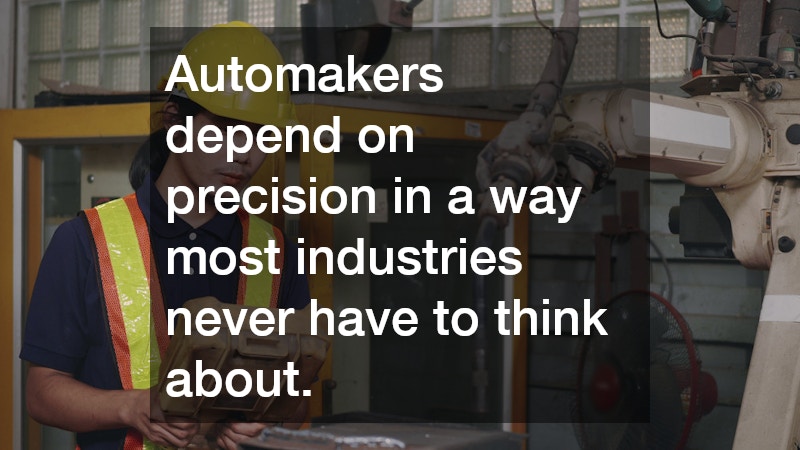
Automakers depend on precision in a way most industries never have to think about. A component that is off by even a fraction of a millimeter can create performance issues, excessive wear, or safety concerns once a vehicle reaches the road. That pressure for accuracy is one of the main reasons CNC manufacturing has become deeply embedded in the automotive industry.
Why CNC Manufacturing Is Essential for Modern Automotive Production
Modern automotive facilities operate on incredibly tight schedules. Manufacturers are expected to produce thousands of parts that fit together flawlessly while keeping costs manageable and minimizing downtime.
CNC manufacturing helps make that possible because the entire process is digitally programmed and highly repeatable.
When a machining program is created for a component, the system can reproduce that same part repeatedly with minimal variation. That consistency matters for critical automotive systems like:
- Engine assemblies
- Brake components
- Transmission housings
- Steering systems
In older manufacturing environments, manual machining often introduced inconsistencies between parts. Even highly skilled machinists could produce slight variations over time. CNC equipment reduces that variability significantly, which improves reliability and shortens quality inspection cycles.
Material flexibility is also important. Modern vehicles rely heavily on lightweight metals and specialized composites to improve fuel economy and battery efficiency. CNC manufacturing can precisely machine aluminum, titanium, stainless steel, and engineered plastics without compromising structural integrity.
That capability has become especially valuable for electric vehicle production, where weight reduction directly affects battery range.
Automotive Parts Commonly Produced With CNC Manufacturing
Some automotive components demand such extreme precision that CNC machining is often the only practical production method.
Engine components are one of the clearest examples. Parts like cylinder heads and pistons operate under intense heat and pressure, so dimensional accuracy is critical. Even a small defect can affect combustion efficiency or lead to premature engine failure.
Transmission systems also rely heavily on CNC manufacturing because gears and drivetrain parts must mesh together perfectly. A poorly machined gear can create vibration, noise, or long-term wear issues that become expensive warranty problems later.
Electric vehicles have introduced another layer of demand. Manufacturers now require specialized battery enclosures, cooling plates, and motor housings that can handle heat management while remaining lightweight. CNC systems allow engineers to create these complex shapes with high repeatability.
In performance automotive shops, CNC manufacturing is also central to aftermarket customization. A racing team, for example, may need custom suspension mounts or lightweight performance components within days rather than weeks. CNC machining makes that turnaround possible without sacrificing precision.
How CNC Manufacturing Improves Automotive Prototyping
One of the most frustrating parts of automotive development is discovering a design flaw late in production. By that stage, delays become extremely expensive.
CNC manufacturing helps reduce that risk because engineers can create functional prototypes early in the design process and test them under real-world conditions.
A typical workflow often looks like this:
- Engineers design the component digitally.
- A CNC machine creates the prototype part.
- The part undergoes testing and inspection.
- Adjustments are made based on performance data.
- The updated design is machined again for validation.
This process allows automotive companies to experiment more aggressively with new ideas while keeping development costs under control.
It also helps manufacturers respond faster to market demands. If a supplier suddenly needs a revised housing design or a custom bracket modification, CNC machining can often produce the updated component within a short timeframe.
That flexibility is particularly important in motorsports and high-performance automotive sectors, where rapid iteration can directly affect race performance.
Key Benefits of CNC Manufacturing in the Automotive Industry
The benefits of CNC manufacturing extend far beyond precision alone.
For large automotive companies, scalability is one of the biggest advantages. Once a machining program is finalized, production can expand without requiring major process changes. Whether a company needs 50 prototype parts or 50,000 production components, the same digital framework can support both scenarios.
Cost control is another important factor. While CNC equipment represents a major upfront investment, it often lowers long-term production expenses through:
- Reduced material waste
- Fewer defective parts
- Lower labor requirements
- Faster production cycles
Manufacturers also gain stronger quality control because CNC systems produce consistent measurements throughout long production runs.
There is also a practical side that many buyers never see. Downtime in automotive manufacturing is extremely costly. A delayed shipment or defective batch can interrupt an entire assembly line. CNC manufacturing reduces that risk by creating more predictable and repeatable production processes.
Emerging CNC Manufacturing Trends in the Automotive Industry
The future of automotive manufacturing is becoming increasingly automated, and CNC systems are evolving alongside that shift.
Multi-axis machining is another growing trend. Traditional machines typically move along three axes, but modern 5-axis CNC systems can create far more complex geometries in fewer setups. That reduces production time while improving accuracy.
Electric vehicle production is also pushing innovation forward. EV manufacturers require intricate thermal management systems and lightweight structural components that would be difficult to produce using older machining methods.
As automotive technology continues advancing, CNC machining will remain one of the industry’s most important production tools. Precision, adaptability, and speed are no longer optional in vehicle manufacturing, and CNC systems provide all three at a scale modern automakers require.