
The seconds following a collision are disorienting, loud, and chaotic. Even a low-speed fender bender triggers a surge of adrenaline that spikes your heart rate, clouds your immediate decision-making, and numbs sensory awareness. In that high-stress environment, drivers frequently make reactive choices—waving off medical attention because they feel fine, or allowing an unvetted wrecker service to haul their car to an unknown storage lot. These early oversights often lead to compounding challenges later, such as unaddressed internal whiplash injuries, structural frame faults that void safety ratings, and protracted disputes with insurance adjusters.
True post-incident recovery rests on two equal pillars: structural and mechanical restoration of your vehicle, and biomechanical rehabilitation of your physical health. Treating these tracks separately or prioritizing one over the other leaves you vulnerable. A meticulously repaired car offers little peace of mind if chronic spinal pain keeps you from sitting comfortably behind the wheel; similarly, full physical recovery cannot protect you if your vehicle returns to the road with compromised crumple zones or uncalibrated forward sensors.
Executing a methodical, phased strategy removes guesswork from the equation. By approaching the aftermath of a wreck systematically—from securing the roadway to executing powertrain rebuilds and seeking clinical alignment—you protect both your financial investment and long-term well-being. The following checklist outlines the essential automotive and therapeutic steps required to ensure complete, uncompromising recovery.
1. Immediate Scene Control and Transport Logistics

The moments immediately following impact dictate the trajectory of your legal protections, insurance claim validity, and vehicle safety. Before worrying about estimates or repair schedules, you must eliminate secondary collision risks. Highways and busy surface streets present continuous danger from distracted passing motorists who may fail to notice a disabled vehicle in time to stop.
- Turn on your emergency hazard flashers immediately. If the vehicle is drivable and you are on a high-speed corridor, guide it onto the nearest shoulder or well-lit emergency turnout.
- If the vehicle is immobilized in active lanes, keep your seatbelt fastened until it is safe to exit, then step over roadway barriers or onto elevated embankments away from the flow of traffic.
- Place warning triangles or emergency flares fifty to one hundred feet behind the impact zone to alert approaching traffic.
- Capture comprehensive, wide-angle photographs of the entire scene before any vehicles are shifted. Document skid marks, broken debris patterns, gouges in the pavement, speed limit postings, weather conditions, and relative vehicle positions.
- Photograph property damage from multiple angles, paying close attention to wheel alignments, leaking fluid trails, and panel gap inconsistencies.
- Request dispatch to send a law enforcement unit so an official incident report is filed, and note down the responding officer’s name, badge number, and report identification code.
Once physical safety is established, you must oversee vehicle transport. Allowing an unverified operator to clear your car often results in inflated storage fees at private impound yards that refuse access to insurance adjusters. Insist on a reputable car towing company that operates modern flatbed haulers rather than conventional wheel-lift trucks. Modern drivetrains—especially all-wheel-drive configurations, hybrids, and electric platforms—suffer catastrophic differential and electric motor damage if pulled with drive wheels on the ground. Specify that the vehicle must be delivered directly to a dedicated, certified collision center rather than an intermediate holding yard, eliminating double-hook transport fees and preventing unnecessary days of weather exposure with cracked windows.
2. Structural Frame Realignment and Exterior Shell Restoration
Modern vehicles are built using unibody architecture engineered to dissipate kinetic energy through controlled deformation. While this design protects passenger compartments during impacts, it means that even moderate collisions can compromise hidden load-bearing channels, rocker panels, and core structural pillars. Surface cosmetics such as a snapped bumper cover or bent fender rarely reveal the true scope of frame displacement beneath the exterior skin.
Restoring baseline crashworthiness requires specialized collision repair facilities equipped with computer-assisted, three-dimensional measuring systems. Technicians anchor the vehicle chassis to heavy-duty alignment benches, utilizing optical lasers or ultrasonic sensors to cross-reference factory coordinate specifications down to the millimeter. If suspension mounting points or engine subframe rails show even slight deviations, the car will track unevenly down the road, chew through tire tread irregularly, and fail to deploy supplementary restraint systems correctly in future collisions.
- Insist on a three-dimensional laser chassis measurement sheet demonstrating that all unibody datum points match factory tolerances before bodywork begins.
- Require that damaged impact bars, crash cans, and unibody structural rails are replaced rather than heated and hammered straight, as thermal cycling destroys the tensile strength of ultra-high-strength steel alloys.
- Examine gap lines between hood, fenders, doors, and quarter panels; uneven seams consistently indicate underlying structural twist.
- Inspect the vehicle’s glass envelope for micro-fractures, delamination, and seal integrity along the roof arches.
A compromised front glass assembly requires immediate, certified windshield replacement to preserve structural cabin integrity. In modern automobiles, front automotive glass provides up to thirty percent of the cabin’s structural roof-crush resistance during a rollover incident, while also serving as the primary backstop for passenger-side airbag deployment. Furthermore, modern windshields house the forward-facing optical cameras and radar arrays that power lane-keep assist, automated emergency braking, and adaptive cruise control. When new glass is installed, the facility must perform dynamic or static sensor recalibration to ensure safety assistance systems interpret road markings and stopping distances accurately.
3. Powertrain Inspections and Drivetrain Diagnostics
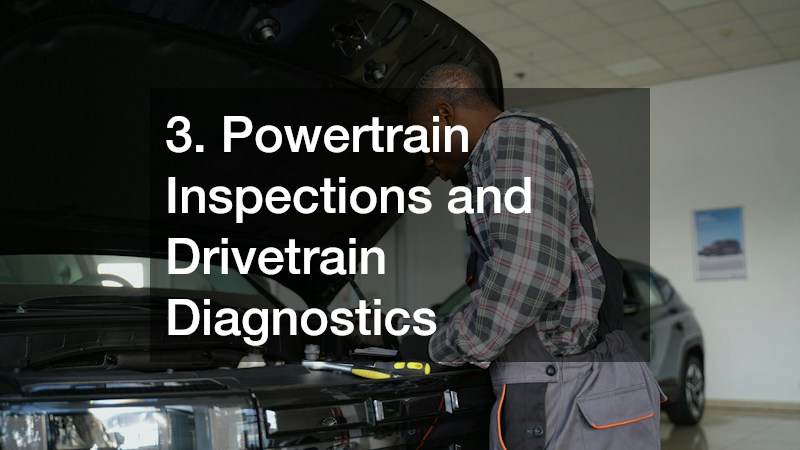
Severe deceleration forces generate severe mechanical stress throughout the engine bay and drivetrain assembly. Components that appear intact externally may have sustained hairline cracks, sheared mounting bolts, or internal hydraulic failures due to sudden directional shock. Operating a vehicle after a collision without a comprehensive mechanical evaluation risks compounding localized damage into complete powertrain failure.
Every mechanical assessment must begin with a full pre-scan of all vehicle computing modules. Modern vehicles rely on decentralized electronic control units that record diagnostic trouble codes for minor voltage drops, intermittent sensor dropouts, and circuit breaks. Taking the car to an experienced auto repair facility ensures that underlying electronic anomalies—such as pinched wire harnesses, misfiring sensor arrays, or fractured vacuum actuators—are diagnosed and rectified before they manifest as chronic breakdowns on the highway. Technicians can perform active actuator tests, inspect bent cooling packs, and replace sheared motor mounts that otherwise transmit harsh harmonic vibrations through the cabin.
- Run a complete electronic scan across the engine control module, body control module, and electronic stability system to log historical and active fault codes.
- Inspect cooling packages, including the radiator, air conditioning condenser, transmission fluid cooler, and intercooler, checking for bent fins, hairline tank fractures, and leaking crimped fittings.
- Examine the engine harness along firewall passages and near frame rails to ensure insulation has not been abraded or pinched by shifted metal components.
- Check exhaust hangers, catalytic converter heat shields, and manifold studs for stress cracks caused by powertrain movement during deceleration.
Specialized attention must be directed toward the drivetrain, where sudden halts place extreme torsional load across planetary gears, clutch packs, and differential ring gears. If the driven wheels were locked or forced backward during the collision, booking a specialized transmission repair service is critical. Internal shock loads can fracture internal sprags, displace torque converter thrust washers, or jam delicate shift solenoids inside the hydraulic valve body. Technicians must drop the transmission pan to inspect for metallic sludge, check fluid clarity for thermal degradation, and verify that drive axle output shafts and universal joints rotate true without lateral runout.
4. Hydraulic Stopping Systems and Critical Mechanical Assembly
When rebuilding safety systems following a roadway incident, components responsible for vehicle control and kinetic energy reduction demand zero compromises. Your suspension linkages, steering racks, and stopping architecture absorb severe localized loads whenever an impact forces the wheels against curbs, roadside barriers, or another vehicle’s chassis.
The hydraulic stopping assembly is particularly vulnerable to impact forces and thermal shock. A comprehensive inspection of your vehicle’s brakes must go beyond measuring friction pad thickness. Calipers can bind on guide pins that have been slightly bent by side impacts, resulting in continuous pad drag, excessive rotor heat, and sudden vapor lock. Brake lines—both rigid steel routing and flexible rubber lines—must be inspected for crimping, ballooning, or abrasion against newly shifted chassis components. Technicians should flush the hydraulic fluid completely to remove moisture and contaminants, test the anti-lock brake module for pressure anomalies, and resurface or replace distorted rotors to ensure smooth, immediate stopping response.
Equally important is the provenance of every replacement item ordered during reconstruction. You must mandate that the shop sources authentic, factory-approved auto parts rather than low-grade, untested salvage components. While generic copycat parts may resemble factory pieces superficially, they frequently feature inferior metallurgy, poor rustproofing, and imprecise mounting holes that degrade vehicle stability. OEM or verified CAPA-certified parts guarantee that critical suspension control arms, tie rod assemblies, steering knuckles, and ball joints retain the precise structural yield strength, weight balance, and impact absorption designed by vehicle engineers.
5. Cabin Finishing and Environmental Surface Preservation

Once mechanical, structural, and safety assemblies are fully restored, focus shifts to re-establishing the interior cabin environment and protective exterior finishes. Road collisions frequently shatter glass panels, tear interior sound-deadening mats, and shower the cabin with glass shards and chemical propellant residue from deployed airbags. Restoring the vehicle to pre-accident comfort requires meticulous detailing and protective glass film application.
Replacing side or rear passenger glass leaves the cabin vulnerable to excessive heat, glare, and harmful solar rays if left bare. Installing durable auto window tint restores your interior comfort by blocking intense thermal energy and filtering out high percentages of ultraviolet radiation. Quality ceramic and carbon films protect sensitive interior materials—such as leather upholstery, soft-touch vinyl dash panels, and electronic infotainment touchscreens—from thermal degradation, drying, and premature sun fading that can otherwise diminish resale value.
Applying a uniform, premium car window tinting treatment across all vehicle glass surfaces ensures consistent exterior aesthetics while improving driving safety. A high-grade film dramatically cuts blinding surface glare from the sun and oncoming high-intensity headlights, reducing driver eye fatigue during daily commutes. Furthermore, quality tinted films feature resilient polyester layers bound by high-tensile adhesives; in the event of an unforeseen side collision, this laminate backing helps hold fractured tempered glass fragments together, preventing sharp shards from showering passengers inside the vehicle cabin.
6. Biomechanical Alignment and Musculoskeletal Therapy
Recovering from a traffic collision does not end when you drive your vehicle away from the repair center. The human body is not built to absorb high-velocity directional decelerations, and occupants frequently sustain significant physical trauma even in minor accidents that cause negligible vehicle damage. The violent whipping motion of the head and torso strains stabilizing spinal muscles, tears deep ligament fibers, and shifts spinal vertebrae out of functional alignment.
Many collision-related soft tissue injuries do not present immediate symptoms. The flood of adrenaline experienced during a crash masks physical pain for hours, days, or even weeks. It is common for motorists to awaken days later with severe neck stiffness, radiating shoulder aches, lower back spasms, chronic tension headaches, or tingling sensations in their extremities. Left unaddressed, micro-tears in soft tissue heal with haphazard, inelastic scar tissue, leading to chronic joint restriction, disc degradation, and permanent postural compensations.
Consulting an experienced auto accident chiropractor provides a targeted, non-invasive path to bodily restoration. These specialized practitioners understand the specific physics of collision-induced trauma, utilizing precision spinal adjustments to restore restricted joint mechanics, alleviate nerve impingement, and reduce inflammatory pressure within the spinal column. Through structured spinal traction, active myofascial release, therapeutic stretching regimens, and focused rehabilitative exercises, chiropractic care helps realign healing soft tissues along natural biomechanical lines. This comprehensive approach resolves acute pain while preventing the development of debilitating chronic conditions.
7. Systematic Recovery Timeline
Managing both automotive repairs and personal physical rehabilitation requires tracking multiple deliverables, inspections, and clinical appointments simultaneously. The step-by-step checklist below outlines how to organize your actions from the moment of impact through to complete recovery.
Navigating the aftermath of a car crash is a demanding journey that tests your patience, focus, and energy. Shortcuts taken during the early phases—whether choosing a substandard repair shop, approving second-rate mechanical hardware, or ignoring dull aches in your neck and spine—almost always create costly problems down the road. Treating your vehicle’s structural integrity and your body’s physical health with equal care and rigor is the only reliable way to move past an accident. By following this systematic checklist, you can protect your long-term mobility, preserve your financial well-being, and return to the open road with complete confidence.
